Month: June 2013

  • The Catean farm

    catean_w500

    Web site

    Map reference

    Photo gallery

    The Catean family lives in the lowlands in the village of Rotbav about 20 km north of Brasov. There, they have a dairy where they produce cheese twice daily, while their horses live in a stable a few kilometres northwards, and their sheep stay on meadows a short drive from the farm. Early in the morning we could watch cheese being made more or less manually, first by pouring milk from a milk can through a filter into a large container, then heating the milk to about 40°C and adding rennet to separate the cheese mass from the liquid. After waiting about half an hour, it was time for separation where the cheese mass was lifted by hand into a wide, open container with an opening in one end and being oblique such that the liquid could flow out and being collected in another container. Putting the remaining cheese mass in a porous cloth, and compressing it in various ways, even more liquid was ejected. Finally, the dairy workers tied the cloth tightly around the cheese mass and put wooden boards and weights on the top in order to get rid of even more liquid.

    The three sons of the Catean family, Silviu, George and Ionut, have taken university degrees, but all of them prefer to stay at their parents’ farm. One of them told my guide that it is in their blood to be farmers, and they can’t help it. However, they are running a profitable farm and their products are renowned for their excellent quality.

    All the brothers are members of Slow Food Brasov, and they have been actively participating in a project called Transhumance 2013 where 6 shepherds and a flock of sheep too young to produce milk walked along the whole of the Carpathians from Romania to Poland, via Ukraine, the Czech republic, Slovakia and Poland, a distance of about 1400 km. Actually, transhumance is as old as the hills, often being practised by farmers living in the lowlands bringing their livestock to the highlands in spring and back again in autumn. Besides, nomads have gone wherever there was food for their animals for millennia. However, due to border controls, passports, etc. this has more or less stopped, and it is to be hoped that their project will be an annual event.

    After having paid a visit to their beautiful horses residing indoors due to the strong heat, we went by horse and cart to their sheepfold. Walking on a gravel road, the horse brought us to a sheepfold, while her foal was walking next to her. There, they could both eat as much as they wanted, while we were visiting the sheepfold. It seems like Romanian sheepfolds are organised in more or less the same way, with an outer fence and an inner one located next to a shed where the shepherds are milking the sheep. The sheep enter through two openings in the shed, before getting milked by one of four shepherds. It was unbearably hot with no shade, but the sheep were waiting patiently, and the horse was sweating heavily. How man and animals survive, I have no idea, but probably the horses and the sheep best suited to the heat have been selected for breeding since ancient times. Going back again in a horse-drawn cart, we passed a nest of storks, 3 chickens and one adult. How they survive the heat is another mystery.

  • The Cizmas farm

    cismas_w500

    Map reference

    Photo gallery

    After having left Sighisoara on the way to Brasov, we turned left and arrived soon after at the organic farm of Dan and Tincuta Cizmas in the village of Topa.

    We were met by Dan Cismas, who invited us to enter a room where he and his wife Tincuta display some of their products, like jams and herbal teas. The jams were in hexagonal glasses, while the herbal teas were packed in plastic bags with labels made by Tincuta’s cousin.

    Their farm is certified as an organic farm and having 34 hectares of land is enough for self sufficiency. Dan said that the locals only cultivated corn and potatoes, but he wanted to be a model farmer for other people in the village and he said that if you intend to have an organic farm you need to constantly improve your way of farming and always be willing to try something new. His goal is to make farmers running conventional farms to convert to organic farming.

    The family has 4 children, two sons and two daughters, and his youngest son repairs their tractors and other machines.

    The family also cultivates one hectare of Damask roses, renowned for their fine fragrance,  in order to make jam and tea. Dan proudly told my guide that 25 % of income from the farm comes from rose jam.

    They collect many medicinal herbs for tea and they are also growing vegetables in greenhouses. They sell their products in Bucharest and Brasov where they have 20 families to which they deliver jam and tea once a week.

    They have 15 cows and a few goats from which they get milk. Three times a week they deliver milk and cheese to families in Sighisoara, and they deliver milk twice weekly to select families in the village of Topa.

    The Cismas family produces 4 to 5 types of cheese, among others a cheese called telemea – salted cheese with herbs. The family cooperates with other organic producers like beekeepers from the village of Topa, and Dan barters milk and cheese for honey.

    They have two solar-powered driers and a big one with electrical power where they dry herbs for herbal teas, but also vegetables that are cut in small pieces and mixed with salt.

    Dan has been co-president of Eco Ruralis, the national association for small-scale organic and traditional farmers, and he’s doing all he can to prevent landgrabbing in Romania.

    The family receives extra subsidies for organic farming. They also have volunteers from many countries who stay at their farm for some months in order to help them.

    Here is an article about the farm.

  • Ioska Ficzay – butcher

    ioska_w500

    Map reference

    Photo gallery

    We met Ioska in his own restaurant being located near an abandoned salt mine, but after parts of it collapsed, the former hill above the mine has been replaced with a lake with tourist facilities nearby. In fact, Ocna Sugatag was an important salt mining centre from the 14th century onwards; and the salt from the mines was brought by raft down the Tisa river and then on the Danube river.

    Being generous like lots of Romanians, we got a wide selection of his meat products together with water and the obligatory local spririts.

    Talking to my guide, he said that his father was a butcher and he has carried on the family tradition. He also has his own farm where he’s raising pigs, sheep, cows and buffaloes, ensuring a steady supply of fresh meat, but he also buys meat from other producers.

    His products include 15 types of sausages, of which the most popular are kishka, a blood sausage using pig’s intestines as a casing and filling it with pig’s blood and various grain stuffings.

    Ioska smokes his meat products by means of wood shavings from beech, plum trees, and hornbeam. For salting the meat, he leaves it in salt water for 2-3 weeks, then smoking it inside for 2-3 days.

    He’s selling his products in Maramures, and at various fairs in Romania. He’s working on introducing a variety of prosciutto, a type of dry-cured ham, using a secret recipe from his father.

  • The Rednic bakery

    bakeri_w500

    Map reference

    Photo gallery

    The bakery of Anuta Rednic is located in the village of Berbesti in the Mara valley. It has an impressive wayside crucifix with remarkable wooden sculptures dating back to the eighteenth century.

    Anuta founded her bakery in 2002, and she started with two wood-fired and one natural  gas-fired oven. She’s producing breads in different sizes ranging from 300 g to 700 g using flour from the Oas region west of Maramures. Introduction of EU regulations in 2007 has made her business quite difficult and she’s struggling with competition from supermarkets, which sell bread at lower prices than hers. Anuta prefers to use the wood-fired ovens instead of the natural gas-fired one because firewood is cheaper than natural gas.

    Unfortunately, many locals prefer to eat white bread to traditional bread because they make their own bread at home. Her peak season lasts from July to September when most of the locals are working outside on the meadows. Then, they don’t have time to bake their own bread and have to buy bread from Anuta’s bakery and other small bakeries.

    When we entered the bakery, one man and two women were busy working. The man was sliding freshly baked breads out of the oven by means of a peel, that is a shovel-like tool with a long handle, while the women removed the burnt upper crust with brushes before placing the breads in baskets.

    The women also formed dough manually into breads to be baked, while the man put flour, butter, sugar, and water into a kneader in order to make more dough.

  • Haymaking in Maramures

    hay_w500

    Map reference

    Photo gallery

    When travelling around Maramures near the border with Ukraine, people doing manual work in the meadows and tall, round haystacks are a common sight. Workers, men and women, girls and boys, walking along the road with wooden pitchforks and scythes on their shoulders on hot summer days wearing nothing on their heads to protect themselves from the fierce sun are also commonly seen.  Having let industrial agriculture, which has swept across the whole of Western Europe, pass them by they still work as farmers were doing 100 years ago.

    The hay is used to feed their horses and cows from late autumn to early spring and it requires huge amounts of work. From mowing the meadows with a scythe to raking the hay into small heaps and turning it around to make it dry to making huge haystacks to filling a cart with hay and bringing it back to the farm is a type of work which most of our great-grandparents had left behind.

    Having joined a haymaking course  and worked as a volunteer on an overgrown meadow, I can confirm that haymaking is hard work. You have to work on a field with no shade, you need to sharpen your scythe regularly, the ground may be uneven making scything difficult, you may need to scythe or rake upwards, you need to drink water regularly, and preferably take a break occasionally. However, everyone is working towards a common goal, there is no boss such that everyone is equal, everyone works as hard as he/she is capable of.  All these factors contribute to that you feel you are a part of a group and your work is appreciated.

    As regards the haystacks, they are really big. Before making one, three poles are bound together at one point and the opposite ends  are driven into the ground. Then, hay is stacked around the poles such that the height of the haystack may reach heights of 3(?) metres. The workers use ladders to get on top of the haystacks and put even more hay on the top. Being an outsider, it was a beautiful sight to see rows upon rows of haystacks on the meadows, enriching my visual experience. For the locals, it may be something completely different. However, having been haymaking myself, I still think haystacks and hayracks on a freshly mowed meadow look lovely.

    Incidentally, the great Dutch artist Pieter Bruegel painted The Corn Harvest in 1565. Judging from this painting, the characters in the painting would have felt at home at haymaking in Maramures.

    For those who want to know more, this article is highly recommended.

  • Sheepfold near the village of Budesti in Maramures

    Map reference

    Photo gallery

    Having passed the picturesque village of Budesti in Maramures and driving on a gravel road for some kilometres, we arrived at the dwelling of a group of shepherds. Since they were outside looking after their animals, we could at least see that these guys were very practical, having made chairs and tables using trees from the forest in order to make life a little easier. Actually, they were residing at a sheepfold, which we had passed on the way to their house. Approaching on foot, we were met by a bunch of rather fierce livestock guarding dogs, and all we could do was to wait until one of the shepherds arrived. Having been “liberated”, we could finally approach the sheepfold.

    The sheepfold was located in a lovely place, being surrounded by hills and forests, and situated on a meadow. The shepherds were busy milking the sheep and a few goats, while one guy made the sheep enter the shed where they would be milked. Having milked all the animals, they brought the milk in cans and poured it into a large wooden barrel. Heating the milk and adding rennet, the milk was ready to be separated into cheese mass and liquid after about half an hour. Lifting the cheese mass out of the barrel and putting it into porous pieces of cloth which were hung up, the compressing of the cheese mass which were always done in the small dairies we had visited, was replaced by using  the force of gravity only.  After having made the first set of cheese, they poured the remaining liquid into a big pot and heated it on a wood-fired oven.

    After lunch, they stirred the liquid continuously until a thin layer appeared on the top. Having removed it, it was time to get hold of the ricotta cheese. That is, re-cooked cheese. Having placed all the ricotta cheese in a porous cloth and hung it up to dry, the remaining liquid was poured into a round trough where the dogs hungrily slurped it up.

    In the end, the shepherds let out all their animals from the enclosure and started bringing them to the lovely hills surrounding the sheepfold.

    Next to the enclosure, there was a primitive hut made of sticks and plastic in which one of the shepherds would sleep at night since wolves and bears are certainly able to attack their animals.

  • Ionu’ lui Gheorghe – beekeeper

    ionu_w500

    Map reference

    Photo gallery

    Ionu’ is an elderly man who lives in the village of Breb, one of the most picturesque villages in all of Maramures. The village lies at the foothills of the Gutai mountains, and it is quite an isolated village with a population in excess of 2000 inhabitants. The name of the village comes from the beavers which used to live in the lakes and rivers in this area in the past, but now they are extinct. Breb is also known for sulphurous water, and until 1918 you could still see the old baths where it is said that even Emperor Iosif II used to come. It is said that the water is good for stomach diseases.

    Ionu’ has 50 beehives, which he only keeps in his own garden and orchard. He inherited his first beehives from his father-in-law and then he gradually started to learn more about how to keep bees.  Ion told my guide that up to 1950 on the Day of the Cross (Ziua Crucii, an Orthodox celebration on 14 September) the people in the village who had beehives would kill the bees in order to take the honey. They didn’t know what to do with the bees in winter. Then, an Orthodox priest called Mircea Antal came to the village and taught them how to take care of the bees and how to make beehives. From this time onwards, Ionu’ learned how to keep bees properly.

    He is very proud of his honey, and he told my guide that his honey is natural because he doesn’t use any pesticides nor do the other villagers. He sells his honey in the village of Breb and in neighbouring villages.

    Entering his garden, we could see some of his beehives, hay ready to be dried, lots of fruit trees and a big, cylinder-shaped structure of firewood. He willingly opened some of his beehives without using any kind of protection. In order to make the bees more quiet, he blew smoke on them, but this seems to be common among many, if not all, beekeepers.

    At the end of the visit Ion said that he comes from a very old family of nobles, called ‘nemesi’, and he has an old diploma to prove it. He said that he didn’t want to give it to a museum, he just wants to keep it in the family.  He was also very proud of his nephews, both of them officers in the Romanian Army.  They use to come quite often to help him doing the haymaking for the animals.

  • Irina and Vasile Bozai – food producers

    sopp_w500

    Map reference

    Photo gallery

    Irina and Vasile Bozai are running a guesthouse in the village of Desesti in the Mara valley at the foothills of the volcanic Gutai mountains. The village is renowned for its gardens and orchards, and the eighteenth century wooden church that is part of the UNESCO World heritage.

    Like lots of Romanians, Irina and Vasile are very hospitable and they invited us to have a taste of their homemade food. They make food themselves using ingredients only, and we were served a rich selection of cold cuts, cheese, bread, pickled mushrooms in vinegar and olive oil, etc. The last one is made by Irina using a secret recipe.

    They are raising their own pigs and they make their own hams, sausages, etc. Since it had been raining a lot before our arrival, mushrooms were widespread in the nearby forests, and they had bought a large amount of mushrooms from local pickers. In the cellar, we watched a group of women, employed by the Bozai family, cleaning the mushrooms and sorting them in grades of quality. The highest quality ones, which have a maximum diameter of 6 cm, are frozen at -40°C in order to preserve their quality. The rest are cut into thin slices and dried in a storeroom with controlled humidity and temperature.

    The mushrooms are exported to Italy where they are highly appreciated. According to Vasile, the highest quality mushrooms grow near fir trees, but some Italians prefer mushrooms which grow near oak trees. They are also selling pickled mushrooms using Irina’s secret recipe.

    Vasile also intends to buy a fruit press in order to produce apple juice, and he makes plum brandy.

    There is a fish farm next to their guesthouse where trout are raised. It consists of 2 pools where water is continually supplied at the uppermost one and flowing down to the other one. Vasile uses food prepared by a local veterinarian for the fish such that they grow slowly and they are ready for slaughter after about one year. He has been offered animal feed which would let the fish grow much faster, but fortunately he has declined the offer. The youngest fish was staying in the lowermost pool and brought to the highest one after they had reached a certain age. In winter, the fish hibernate and don’t require any food. The pools were about 3 metres deep, which was necessary for the fish to escape the heat on hot summer days. The fish is caught by a fishnet, and sometimes Vasile has to catch all of them, empty the pools and clean them.

  • Sara Filep making a traditional Transylvanian cake

    tran_kake_w500

    Map reference

    Photo gallery

    We went to the village of Sic, which is renowned for its summer festival where the locals are wearing traditional costumes, dancing, singing and performing.

    Sic means salt and the village is named after the nearby salt mines which were at their peak production in the nineteenth century, attracting people from afar and making Sic a town. After the mines were closed, Sic gradually returned to being a village having about 2500 inhabitants.

    We stayed at a guesthouse in Sic and the aunt of the owner, Sara Filep, was fortunately willing to show us how she made a traditional Transylvanian cake called Kurtos Kalacs. It’s shaped like a hollow cylinder and the name Kurtos comes from the word for the shape of a bull’s horn in Romanian.

    Sara mixed flour, egg, milk, vegetable oil, salt and yeast in a bowl and she worked very hard at kneading the dough. While the dough was leavening, one of her relatives put made two parallel rows of bricks on the ground, put some firewood between them and lit a fire. When it was burnt out, it was time to bake the cakes.

    Before starting the baking, she formed small parts of the dough into long and thin lines which she rotated around a wooden cylinder to which was attached a long wooden stick. However, she always applied sunflower oil to the wooden cylinder before attaching the dough in order to facilitate the loosening of the cake after having been baked. Besides, she rolled the dough in sugar.  Having finished this, she let someone else rotate the cylinder above the embers for some time. When all the surface of the cake had become light brown, she knocked the cylinder carefully against the ground such that the cake was released. This procedure was repeated until a lot of cakes had been made.

    It seemed like rumour was spread that this delicious cake was being made or maybe it was the nice smell since people from the village were gradually arriving. Anyway, the cake was delicious and I certainly had my fill.

  • Eugen Duma – vegetable oil producer

    solsikke_w500

    Map reference

    Photo gallery

    Eugen Duma produces vegetable oils derived from sunflowers, walnuts and pumpkins. We met him outside his oil press and he willingly told my guide about his business, which is run by himself and his wife.

    Making vegetable oils was common among the locals in Turda until 2007 when EU regulations regarding food safety had to be followed. This led to that only(?) Eugen Duma is still allowed to sell vegetable oils, while the other ones can only make them for personal consumption.

    Eugen bought his first oil press from an Italian company just after the revolution in 1989, and now he has 3 oil presses where the oil is produced only by cold pressing. That is keeping the temperature below about 30°C in order to obtain the best quality.

    Eugen cultivates sunflowers himself, but he also buys sunflower seeds from other growers. Cultivation of sunflowers is rotated annually, such that one field is cultivated with sunflowers one year, with maize the second year and with wheat the third year.

    He’s a member of Slow Food Turda and he has participated in Slow Food fairs in Bulgaria, Hungary and Croatia. He sells his oils at local markets and in small, specialised food stores.

    The solid stuff remaining after the sunflower oil has been extracted is mixed with maize, barley and other cereals and turned into animal feed.

    Eugen recommended my guide to swallow a spoon of sunflower oil every morning  because of its health benefits.

  • The Kepes family – beekeepers

    antal_w500

    Map reference

    Photo gallery

    Beekeeping was started by the late Laszlo Kepes. Now, the Kepes family, Irina Kepes and her husband, her son and daughter-in-law have more than 200 beehives. They are kept in the villages of Valeni and Stejeris about 15 km from Turda from late autumn to May. Then, they are brought by car to the Oltenia region in the south of Romania because of the acacia forests. Thereafter they go to Resita for the lime trees and northwards to the Ariesului vally for the wildflower meadows and fruit trees.

    The Kepes family has a small shop at the local market, called the Piata Agroalimentara in the town of Turda. Their shop has a wide selection of honey products like acacia honey, honey produced from many different types of flowers, lime tree honey, fir tree honey, besides honey from rapeseed and sunflower. They also sell propolis, vinegar made of apples and honey, box-thorn juice and blackcurrant juice with honey.

  • Mitru Stan – brandy maker

    brenneri_w500

    Map reference

    Photo gallery

    We met Mitru Stan in his distillery, which looked like it had been set up in a closed-down factory. Entering his distillery, the first things I noticed were some big cylinders made of copper, from which protruded tubes which were connected to two huge horizontal metal cylinders. There were also one electric motor next to each copper cylinder and they were probably meant to drive machines which are extracting the juices of the fruits he’s adding to his brandies.

    He first bought three distilleries in the village of Brateiu, which is renowned for all sorts of copper objects made by local coppersmiths. He brought all the equipment to the village of Sadu where he lives and adapted and improved the boilers. The two huge cylinders were used for cooling and they had originally been used as water pipes. Actually, he finished all the work in one month, no mean feat.

    He makes plum brandy, wild pear brandy and cognac. Buying brandy to an old, knowledgeable Saxon man in the village of Garbova in Transylvania, he managed to get the recipe for cognac from the probably inebriated Saxon.

    He has his own plum tree orchard and he buys wild pears from an orchard owner in the village of Marpod.

    He was very upset when he was talking about the tax he has to pay. He has to pay about 60% tax if he is producing more than 50 litres per year. If he is producing only 50 litres, he has to pay half that amount. His distillery is sealed by the authorities and he has to ask them to remove the seals when he’s going to make more brandy. Besides himself, the locals from his village also uses his distillery.

    Mitru sells his products especially from his own shop, but also at different markets in Sibiu.

  • Animal market near Saliste

    marker_saliste_w500

    Map reference

    Photo gallery

    When visiting the Lebu family, my guide was told that there is a big animal market on the outskirts of Saliste three times a year. Fortunately, that happened to be when we were in Saliste. Since a new highway to Sighisoara was being constructed at the same time, the animal market had been moved to a wide field further way from Saliste and having driven on a muddy road for some time and passed some horse-driven carts, we arrived at the market. The market is open for two days, on the first day small animals like sheep and pigs are bought and sold, while on the second, big animals like cows are horses change owners.

    Entering the market, I could see mostly men standing around and talking, while most of the horses were eating hay. One farmer was passing with a horse-drawn cart on which was standing a calf and being followed by a cow, while another one somehow attached a chain around the mouth of a young ox in order to make it walk where he wanted.

    Makeshift bars had been set up and someone was barbecuing meat, while poultry in small cages on the ground were for sale. Lots of horses had red tassels on their heads to ward off evil spirits. They were also for sale together with a large selection of horse harnesses.

    A screaming piglet was brought into a car, but it turned quiet after it had entered the car.

    Unfortunately, not knowing the language made me miss the horse-trading.

  • The Lebu family – sheep farmers

    lebu_w500

    Map reference

    Photo gallery

    We met Constatin Lebu as he was receiving fresh milk brought by car from the three sheepfolds of his family. As usual, the milk was filtered and poured into big containers. then heated up to about 40°C, and his wife Lucretia added rennet to separate the liquid from the cheese mass.

    They have about 2000 sheep, which are split into three sheepfolds, and their two sons are helping with shepherding the sheep.

    Constantin worked for many years during the communist regime as a mechanical engineer in Sibiu. After the Revolution he lost his job, returned to his village, Saliste, and started to raise animals. He had always used to keep a few animals at home. Now, he is dedicating all his time to doing this. His wife, Lucretia is helping to make the cheese, and she is in charge of doing this twice a day, a process which takes around 3 hours. After having separated the cheese mass from the liquid in a porous cloth and put some weights on top in order to squeeze out the remaining liquid, she was finished for the time being.

    Cheese, which had already passed this stage, was put in salt water. First, they put a raw egg in the water. If it rises to the surface, the water is salty enough for the cheese. The salt is used to drive out more liquid, add taste to the cheese, and finish off bacteria.

    Afterwards, bits of sheep’s cheese, called telemea, was put in big, wooden barrels covered on the inside by plastic. When all the cheese had been put in the barrel, they closed the plastic by means of a knot. The barrels are made by a cooper in the Western Carpathians where people are well-known for producing them.

  • Apilife

    apilife_w500

    Web site

    Map reference

    Photo gallery

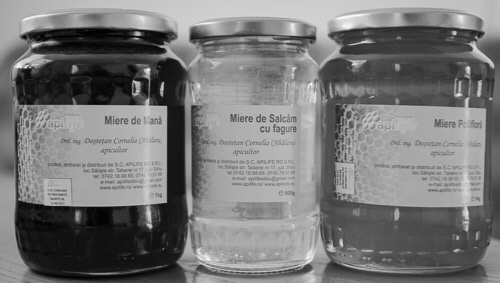
    We went to Cornelia Dostetan’s house on the outskirts of the village of Saliste. There, she has her own laboratory to which she brings honey from her beehives. In fact, she’s a well-educated woman, having taken a Master’s degree in food safety and a PhD in collecting venom from bees.  Just before our arrival, she had helped organise a seminar on apitheraphy, that is how to derive medicines from bees.

    She has about 20 beehives in the vicinity of where she lives, and to which we went after having learnt about her varied activities regarding bees. She only used a hat with a net around her face to protect herself when she opened the beehives, having been stung in her face before. Anyway, that small collection of beehives was just for demonstrating how she collects honey, propolis, etc. Actually, she has about 300 beehives in the south of Romania, and they are moved around in order to bring the bees close to plants which are flowering at different times of the year.

    Since she’s making medicines for people, she has to to follow very strict requirements to hygiene. The ingredients she is using include:

    • honey
    • pollen
    • bee bread (the pollen from the field bees are taken by the house bees, mixing bee saliva, the plant pollen, and nectar. They also secrete enzymes into the pollen, creating bee bread)
    • propolis (a resin-like material from the buds of poplar and cone-bearing trees, being collected by bees)
    • royal jelly (a secretion from honey bees used to feed larvae and queens)
    • drone larvae

    From these ingredients she makes a mixture for apitherapy – preferably a certain cocktail for each patient. She also makes generic cocktails for women only and men only. However, her main income is face creams derived from honey products.

    Her main interest is to collect venom from bees from which she makes medicines against rheumatic pains. She also plans to use air from inside beehives to treat people with asthma.

    Her products are for sale at pharmacies in Sibiu, but she’s also exporting to France and Germany upon request.

    Being a generous person, Cornelia kindly gave us each a selection of her products.

  • Wilhelm Tartler – beekeeper

    Web site

    Map reference

    Photo gallery

    Wilhelm Tartler is a young Saxon, who after a stay in Germany, has decided to stay in Romania. We met him, his German wife and their young daughter on the outskirts of the village of Hambra next to the Saxon church from which they rent a house. In fact, the house is surrounded by a big garden with some rundown sheds, lots of beehives, Transylvanian chickens, a vegetable garden, and some sheep.

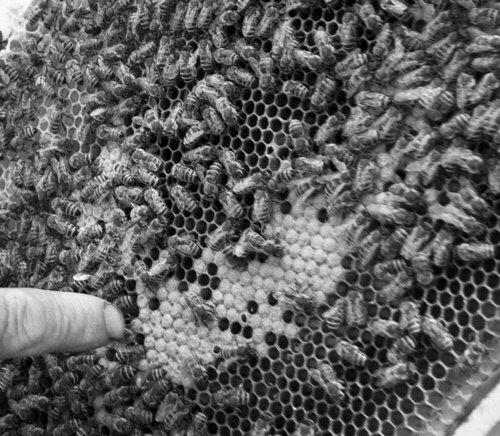
    Wilhelm got acquainted with bees for the first time when he took swarming bees from a tree in 1996, and started producing honey in 1999. He and his wife are producing organic honey with the help of volunteers. During our visit, 3 volunteers were busy working, two of which were making honeycombs by melting and moulding old beeswax, forming a diaphragm which is called a honeycomb. Later, they would be placed in the beehives where the bees would use the honeycombs as a base on which they construct their hexagonal cells. The third one was making a solar oven for melting beeswax.

    This farm accepts volunteers all year as described here.

    Wilhelm willingly showed us his beehives, holding his one-year old daughter in one arm, he deftly opened a beehive. A bit surprising given that bees could have seriously hurt his daughter, but obviously his bees are so peaceful that it’s safe. After having been shown around their property, we were offered a wide selection of their tasty honey products, which they sell in select shops all across Romania, but also to Germany, the Netherlands, and Sweden. Their products include

    • honey from diverse forest flowers
    • acacia honey
    • acacia honey with vanilla
    • acacia honey with walnuts
    • rapeseed honey
    • sunflower honey
    • limetree honey
    • pollen
    • propolis – a reddish resinous cement collected by bees from the buds of trees

    In order produce all these types of bee products, they have a stationary set of beehives in a nearby forest, while the other ones are moved around Romania by a trailer in summer. Sometimes they go to the Danube delta overnight, other times they move the bees tens of kilometers in order to take advantage of the local vegetation.

    Being a passionate beekeeper, he also told us that he selects 2-5 larvae from a good hive with good honey and healthy bees, feed them royal jelly (a honey bee secretion) together with poly-flora honey. This will give 4-5 queen bees, which can be used in other hives.

    In winter, the bees stay in peace, in a bad year they must be fed.

    Wilhelm is also a passionate fruit grower and he has about 60 varieties of apple trees in addition to cherry trees, plum trees, and pear trees. He’s arranging grafting courses in spring where he teaches how to graft young apple tress to old ones and spreading the new ones if they are good. He’s also growing raspberries, blackberries and blackcurrants.

    We also visited their chicken coop where tiny Transylvanian chickens were moving freely around as they pleased.

  • The Turean bakery

    turean_bakery-w500

    Map reference

    Photo gallery

    This small bakery is run by Maria Turean and her husband. He was working in a bakery in the village of Sura Mica before the revolution in 1989, but it was closed afterwards. Some time later he opened a small bakery in the same village, consisting of a small shop and a traditional oven. Since Romania joined the EU, he had to close down the old, traditional oven and install a new one because of EU regulations.

    Arriving early in the morning, we could hear somebody hitting something. After having entered the bakery, it was seen to be caused by two men who were hitting big, round and freshly baked breads with sticks. In fact, this seems to be a holdover from the Transylvanian way of making bread where the top of the breads are baked till the crust has burnt, and getting rid of it by hitting it repeatedly with sticks.

    At the same time, other bakers started making cozonac, actually a sweet bread whose dough consists of flour, eggs, milk, butter, sugar and salt. They started by placing some dough on a workbench and making it flat by means of a rolling pin. Then, they covered the dough with a layer of their own nutty mixture before rolling the dough around itself until it formed a long cylinder. Since it was so long, two bakers had to lift the dough into a metal trough. After leavening, the cakes were baked and ready for sale. Actually, this way of making the cozonac is a continuation of how the Saxons in Transylvania used to make it.

    The owners kindly gave us a cozonac, a tasty cake which is very popular among Romanians for all sorts of celebrations.

  • Bebeselea mountain farm

    bebeselea_w500

    Map reference

    Photo gallery

    About 30 km west of Sibiu, the village of Jina is located at the foothills of the Cindrel mountains, being part of the ethnographic area called Marginimea Sibiului also known as “the Land of the Cheese” being renowned for producing various types of cheese. Although some local shepherds found greener pastures elsewhere (no pun intended) and didn’t return, there are still many mountain farms in active use, called coliba, in Jina.

    After having tasted the obligatory homemade spirits at the home of the Bebeselea family, we were brought by tractor and cart by Ion Bebeselea on a muddy and slippery road up to their mountain farm located on a hillside overlooking a lovely valley, having a beautiful view of the surrounding countryside and being surrounded by meadows.

    The mountain farm was quite homely with a large bedroom and a  kitchen with a large dining room, but considering that they have to milk their cows twice daily all year, it’s really understandable that they need it. They also had a small dairy, a barn for the cows and another one for the calves together with a pigsty and a shed for their chickens.

    Cornelia told my guide that the cows produce more milk when she’s milking the cows than when her husband does it. Thus, she and her youngest daughter Mariana were milking the cows together, both their own and some cows belonging to some elderly villagers who prefer to stay in the village. After having milked all the cows and one donkey, her husband brought the milk to the dairy above the barn (husbands have to do something, haven’t they?). Having poured all the milk through a filter into a container and having added rennet in order to separate the fat and the  liquid parts of the milk, we went to their kitchen where Cornelia prepared an abundant meal for us consisting of their own cheese, polenta, bread,  water for drinking and the always indispensable home-made spirits. In general, Romanians are very hospitable and it seems like they love to serve their guests plenty of food and at least two shots of their home-made spirits.

    After having finished our meal, the milk was ready to be turned into cheese. As always, this consists of bringing the fat parts into another container and getting rid of the liquid parts by means of compressing and gravity. The first one is done by putting the cheese mass in a porous cloth and compressing the cheese mass, while the last one is done by letting the cheese mass stay put and letting the liquid parts flow downwards into another container. Often, weights are put on top of the cheese mass in order to speed up this process. Cornelia did this expertly and after having put the cheese in the storage room, her husband brought the remaining liquid to the piglets where it was consumed quickly and noisily. The cheese would be sold at markets in Bucharest and Galati in the autumn.

    Initially, Cornelia and Ion had bought the mountain farm themselves and gradually expanded their property by buying up adjacent land. They receive subsidies for each cow from the state and also for each hectare of land they own.

    As regards scything the meadows, workers from other parts of Romania come to Jina and Ion employs them for whatever time is required.

  • Outdoor market in Saliste

    Map reference

    Photo gallery

    Just by coincidence, there was an outdoor market in Saliste, the place of our first overnight stay.

    An empty building had been turned into a shop for selling home-made cheese, which was sold out of the windows by elderly women.

    A rich selection of vegetables were for sale, while cardboard boxes were used to house chickens for sale.

    A makeshift bar and kitchen had been set up where the locals were drinking and socialising, and a young woman was barbecuing various types of meat.

    A man was selling hats in all shapes and sizes, and a woman was selling clothes. Walking further on, various types of poultry inside tiny cages on the ground were for sale together with corn and other cereals.

    It was quite crowded, and it seemed like it was very popular among the locals.